

Members of Congress sit on committees that oversee the industries they trade. The long side buys what several members bought in the last 30 days; the short side sells what they sold. Being market-neutral, the strategy tests the signal rather than the direction of the market.
Congress Long-Short.
Long what they buy, short what they sell.
Buys the stocks members of Congress bought in the last 30 days and shorts the ones they sold. Market-neutral. Also in the app: Senate and House versions, committee copies and individual politicians.
The rules. Long one side, short the other.
- Score
- Members buying minus members selling each stock over the last 30 days.
- Long and short
- Positive score = long, negative = short, 100% of capital on each side.
- Size
- Up to 30 long and 30 short positions.
- Entry
- On the disclosure date, never on the trade date.
- Rebalance
- Weekly, with 0.1% costs per trade.
Congress portfolios. Side by side.
| Strategy | Return | S&P 500 | Sharpe | Max drawdown | Since | Live since publication |
|---|---|---|---|---|---|---|
| Congress Long-Short | +1.1% | +1.7% | 0.31 | −8.4% | 2026-07-20 | – |
| House Long-Short | −1.5% | −1.2% | -0.23 | −8.8% | 2026-07-20 | −3.9% since 2026-11-13, max drawdown −3.9% |
| Congress Buys | +0.2% | +1.0% | 0.13 | −6.9% | 2026-07-22 | – |
Updated 2026-11-09. Simulated on historical data with 0.1% costs per trade, before taxes; returns are cumulative since the start date. The live column starts on the day the strategy was published and is never recalculated, with the same 0.1% costs. Past results do not predict future ones.
From disclosure to position.
01DisclosedA member files a Periodic Transaction Report with the House or the Senate, up to 45 days after the trade.02CountedFor each stock, Bourse counts how many members bought and how many sold in the last 30 days.03SplitNet-bought stocks go long and net-sold stocks go short, so the market’s direction largely cancels out.04WeeklyEvery week both sides are rebuilt with whatever was newly disclosed.
Two sides of the aisle. Two sides of the trade.
The STOCK Act allows up to 45 days between a trade and its disclosure. Every position here opens on the disclosure date, which is the earliest anyone outside the office could act.
Amounts are reported in ranges, many trades are made by spouses or advisers, and a handful of very active members can dominate a month. Check the member list in the app before you rely on any single week.
About Congress trading. Answered.
Why market-neutral?
To measure whether Congress picks beat other stocks, not whether the market went up. A long-only copy mostly follows the S&P 500.
Do spouses’ trades count?
Yes. Disclosures cover the member, the spouse and dependent children, and all of them count the same.
Can I copy a single politician?
Yes. The app has a portfolio for every active trader in Congress, including Nancy Pelosi, plus Senate, House, party and committee versions.
Go to the source. Every member.
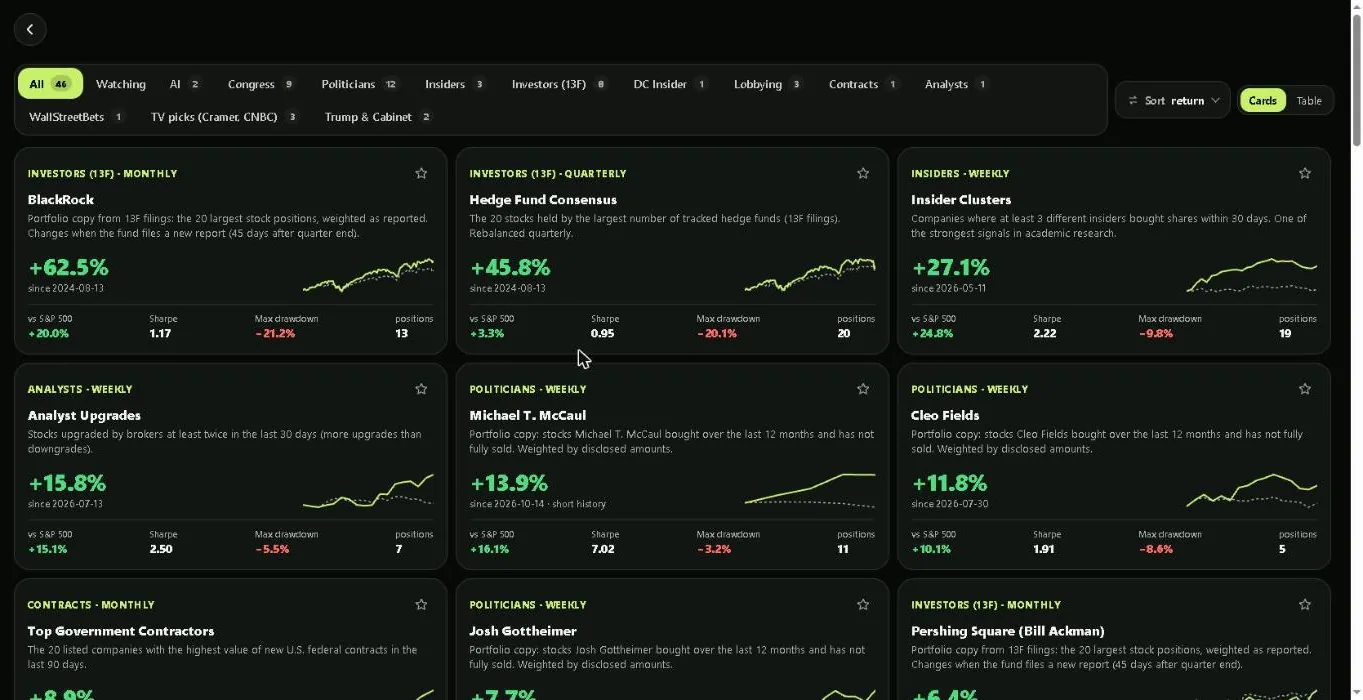
All Strategies
Every strategy follows a clear rule, only uses data that was public on the day, and is recomputed daily after the close, with trading costs.
All Datasets44 datasets built from official filings and public sources, cleaned, matched to listed companies and updated around the clock. Through the API: 57 datasets.
RadarOne live feed for Congress trades, insider buys and sells, institutional filings and market signals - filtered, explained and pushed to your phone.
Washington trades. You can see it.
Bourse provides financial data and editorial information, parts of which are generated by AI. This page is for general education only. It is not personalised investment advice or a recommendation to buy or sell any financial instrument. Make your own decisions.