

One famous manager buying a stock is a headline. Fifty funds adding the same name in the same quarter is positioning. Institutional Consensus counts how many tracked funds hold, add or cut each ticker, so you see where capital is crowding and where it is leaving.
Track the smart money.
13F institutional portfolios.
Track sector rotations, institutional crowding and the exact holdings of top funds (Buffett, Burry, Ackman, Marks) from the day they file with the SEC. Institutional Consensus shows the most bought and sold tickers across every tracked fund at once.
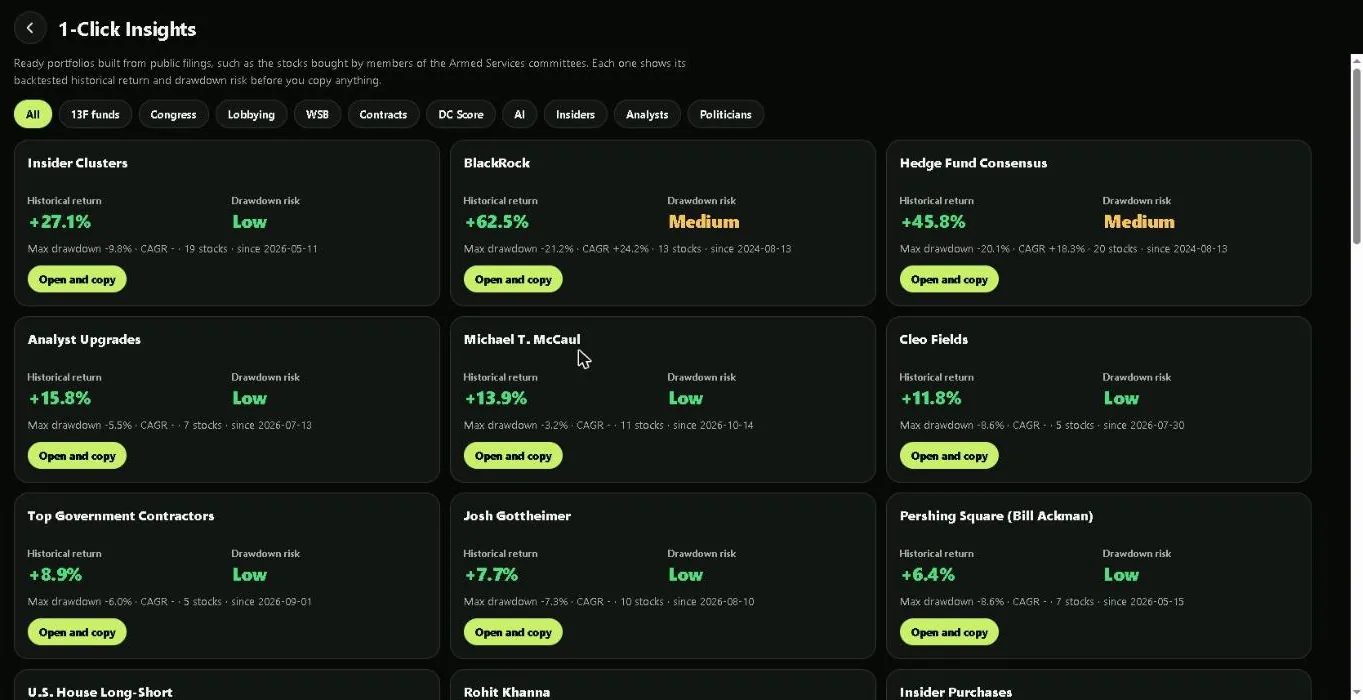
Fund copies. Real filing dates.
| Strategy | Return | S&P 500 | Sharpe | Max drawdown | Since | Live since publication |
|---|---|---|---|---|---|---|
| Hedge Fund Consensus | +45.8% | +42.5% | 0.95 | −20.1% | 2024-08-13 | – |
Updated 2026-11-09. Simulated on historical data with 0.1% costs per trade, before taxes; returns are cumulative since the start date. The live column starts on the day the strategy was published and is never recalculated, with the same 0.1% costs. Past results do not predict future ones.
The rules. Filed, then copied.
- Source
- Form 13F-HR filings of the largest funds and best-known investors, from SEC EDGAR.
- Entry
- On the filing date, never on the quarter end the report describes.
- Portfolio
- The 20 largest holdings of each investor, weighted as reported.
- Consensus
- Hedge Fund Consensus buys the stocks the most tracked funds hold and add.
- Rebalance
- When a new 13F is filed, about once a quarter, with 0.1% costs per trade.
Smart money with a 45-day lag.
A 13F shows holdings at quarter end and arrives up to 45 days later. Many sites compute returns from the quarter end, which nobody could have traded. Bourse enters every position on the filing date, so the backtest only uses what was public that day.
Short positions, cash, bonds and most non-U.S. stocks are missing, and options are reported without strikes. Treat a 13F portfolio as a long-only view of a manager’s U.S. book, not the whole fund.
One quarter in four steps.
- 1Quarter ends
A fund holds its positions on the last day of the quarter.
- 2Filed
Up to 45 days later its 13F lands on SEC EDGAR.
- 3Entered
Bourse rebuilds the copy on the filing date from the 20 largest holdings.
- 4Compared
Each investor is measured against the S&P 500 from the first filing on record.
Funds, from every angle.
All Strategies
Every strategy follows a clear rule, only uses data that was public on the day, and is recomputed daily after the close, with trading costs.
All Datasets44 datasets built from official filings and public sources, cleaned, matched to listed companies and updated around the clock. Through the API: 57 datasets.
RadarOne live feed for Congress trades, insider buys and sells, institutional filings and market signals - filtered, explained and pushed to your phone.
About 13F copies. Answered.
Isn’t 13F data out of date?
It is up to 45 days old when it arrives. That is exactly why the backtest only trades on the filing date: whatever edge survives the delay is what you see.
Why only the top 20 holdings?
Large funds hold hundreds of positions. The 20 largest carry most of the conviction and keep the copy tradable. The API has every row of every filing.
Which investors are covered?
Every fund with a complete 13F history in Bourse gets its own copy strategy, listed in the app with its backtest. Coverage grows as more histories are loaded.
Next 13F season is weeks away.
Bourse provides financial data and editorial information, parts of which are generated by AI. This page is for general education only. It is not personalised investment advice or a recommendation to buy or sell any financial instrument. Make your own decisions.